


Have you ever wondered why your competitors can produce products that look just as good as yours, yet at a lower cost-while your own offerings don't stand out in durability or reliability? The secret often comes down to how they choose their tubular motors. With over a decade of experience in the tubular motor industry, we'll show you exactly how to pick the right motor for your products.
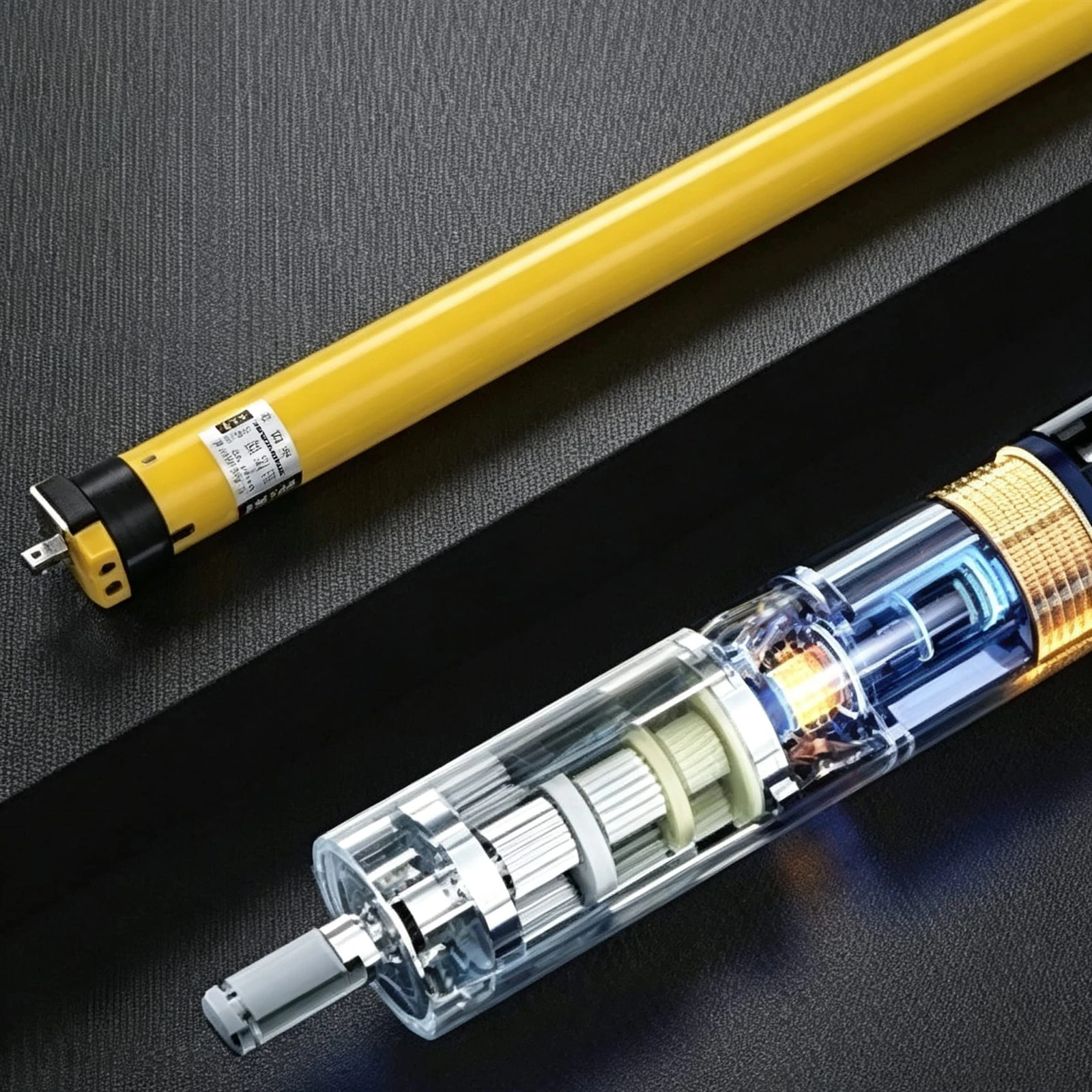
1. What factors really affect your torque selection?
Start by knowing exactly where and how your shade will be used-that dictates not just the motor but also the accessories. For indoor residential applications (living rooms, bedrooms, offices), waterproofing and wind resistance are minor concerns; the focus is on quiet operation and aesthetics. We offer a motor specifically for indoor quiet-use scenarios, with noise levels ≤30 dB-so low that you'll barely notice it's running. For outdoor areas with some splash exposure (balconies, under eaves), you need to factor in occasional water spray and sunlight. And for fully exposed outdoor installations (building facades, unsheltered awnings), wind loads, high heat, and waterproofing become critical. That's why we developed an IP65-rated waterproof motor for our pergola customers.
Usage intensity also matters. For residential use, you're typically looking at 2–3 cycles a day, so thermal load isn't a major issue. But for commercial settings-up to 10+ cycles daily-you need to consider duty cycle and system heat dissipation. For high-frequency commercial applications, we recommend DC motors, which generate minimal heat and handle constant start/stop operation with ease.
Fabric type and shade dimensions are equally important. Here are some common material weight references: lightweight roller fabrics (~1–2 kg/m²), medium-weight sunscreens (~2–4 kg/m²), and aluminum foam slats (~4.5–6 kg/m²). Width and height determine total weight-the heavier the material, the higher the torque you'll need. Our lineup goes up to 300 N·m.
2. Next, sizing your torque-this is where you save the most money.
Torque is the core specification, yet many manufacturers habitually "over-spec" -choosing a 10 N·m motor when 6 N·m would do, or 15 N·m when 10 is sufficient. It sounds safe, but run the numbers: each step up in torque raises procurement cost by 15–30%. If you ship 10,000 units a year, an extra $3 per unit means $30,000 in lost profit-and your customers won't even notice the extra torque. Your cost advantage quietly erodes.
Here's a quick formula to estimate the torque you actually need for any shade type:
Required torque (N·m) = Total fabric weight (kg) × Roller tube outer radius (m) × Safety factor
How to choose the safety factor? Tailor it to the application:
|
Application Scenario |
Recommended Safety Factor |
Notes |
|
Indoor small roller shades |
1.5 |
No wind load, smooth operation |
|
Indoor large systems |
1.8 |
Larger surface area adds cumulative resistance |
|
Outdoor sheltered awnings |
2.0 |
Light breeze and temperature swings |
|
Fully exposed outdoor systems |
2.2–2.5 |
Must handle wind pressure and high heat |
If your product includes side guides (e.g., wind-resistant or zip-screen shades), rail friction adds roughly 15–25% extra load-multiply your total torque by a correction factor of about 1.2.
Real-world example:
An outdoor roller shade, 2.5 m wide × 3.2 m high, using 40 mm foam slats (4.5 kg/m²).
Fabric weight = 2.5 × 3.2 × 4.5 = 36 kg. Tube radius = 0.04 m. Safety factor = 2.0.
Base torque = 36 × 0.04 × 2.0 = 2.88 N·m.
With side guides, add 20% → final recommendation: 4–5 N·m motor-just enough, no excess, no risk.
Master this calculation, and you can achieve 100% of the real-world performance with only 80% of the motor cost your competitors are paying.
3. Heat and water resistance for outdoor shades-your reputation hinges on it.
Indoors, customers care about looks and quietness. Outdoors, they care about whether the shade still works after rain, sun, and wind. That comes down to two hard metrics: Ingress Protection (IP) rating and thermal protection.
IP rating breakdown:
|
IP Rating |
Protection Level |
Best Suited For |
Cost Tier |
|
IP44 |
Splash-proof, blocks particles ≥1mm |
Sheltered outdoor (balconies, under awnings) |
Entry |
|
IP54 |
Resists water spray, dust-protected |
Fully exposed, typical wind/rain conditions |
Mid-range |
|
IP65 |
Protected against powerful water jets, fully dust-tight |
Coastal/high-salt areas, severe weather, industrial sites |
Premium |
When quoting, don't default to the cheapest IP44. Instead, ask proactively: "Is there any risk of water splashing, and how severe?" For light splash, recommend IP54 and explain: "That extra layer of protection extends service life by 2–3 years and significantly reduces maintenance costs." For heavy exposure, recommend IP65. This shows expertise and gives you room to price higher.
Now, thermal protection.
Nearly all AC tubular motors have a built-in thermal cut-off that trips at 135°C–140°C, then resets after cooling. That's a safety feature, but frequent trips lead to poor user experience and eventual motor damage.
How to avoid it?
a. The simplest way: use a DC motor-it generates almost no heat during operation.
b. When sizing, leave a comfortable torque margin-keep the motor running at 60–80% of rated load for cooler operation.
For dark-colored tubes, direct sunlight can raise internal temperatures 15°C–20°C above ambient, so factor in extra headroom for heat dissipation. Some customers use these in lift-and-slide window applications, where after-sales service is especially difficult-so proper sizing is even more critical.
4. The real edge over competitors? Smarter inventory management.
Many shade manufacturers fall into this trap: every order brings a new procurement headache-this time 10 N·m with limit switches, next time 15 N·m with remote, then 6 N·m without limit. Their warehouse ends up packed with a dozen different models, each with shallow stock-no bargaining power with suppliers, slow order turnaround, and they lose ground to competitors.
A smarter approach: streamline your inventory. Analyze your order data from the past year, and group products by two dimensions: "installation environment + fabric weight." You'll likely find that 80% of orders cluster around just 2–3 torque ratings. Make those your "standard models"-buy them in bulk, stock them consistently. That cuts procurement costs and eases inventory pressure. For any special requirements, treat them as "custom orders" and charge a premium, turning variety into extra profit.

5. Make accurate motor selection your competitive moat.
Looking back at the thousands of shade manufacturers we've worked with, success never came from a "magic" motor brand. It came from having a reliable instinct-and this article is exactly where that instinct comes from, grounded in over ten years of industry experience. If you're still unsure about which tubular motor fits your needs, reach out to our team. We'll quickly give you a tailored recommendation and help move your business forward.
FAQ
Q: What are the common application scenarios for tubular motors in residential settings?
A: Tubular motors are commonly used in the following scenarios: electric roller blinds – blackout blinds for bedrooms, living rooms, and studies, controlled by remote or smart home systems for raising and lowering. Blinds and Roman shades – which allow precise light adjustment and privacy control. Outdoor awnings – retractable awnings for patios and balconies, which can be automatically adjusted by sunlight sensors, and in this scenario, the overall size of the tubular motor needs to be larger. Roller shutters for doors and windows – security shutters that are easy to open and close. Electric projection screens – for home theaters, enabling the screen to be raised and lowered. Smart drying racks – electric lifting clothes drying racks.
Q: How to choose the right torque for motorized blinds?
A: Torque is the most critical parameter for tubular motors – too little torque will cause starting difficulties and motor overheating; too much torque will increase cost, noise, and tube stress. The core principle of selection is precise matching – neither blindly choosing a larger one nor taking the risk of a smaller one. Required torque (N·m) = total fabric weight (kg) × tube radius (m) × safety factor. More detailed explanations and case studies are provided in the main text.
Q: Comparing different types of tubular motors for window coverings.
A: Tubular motors are mainly divided into two major types: AC (alternating current) and DC (direct current). AC motors are powered directly by mains electricity (110–120V or 220–240V) and are the most mature and reliable solution. Most AC motors use mechanical cam limit switches, adjustable with a screwdriver at the motor head, while high end models adopt electronic limits. DC motors are powered by low voltage DC (typically 12V, 24V, or 36V) and use brushed or brushless DC motors. Modern residential tubular motors mostly use 24V brushless DC (BLDC) motors, which can achieve soft start and soft stop, greatly reducing mechanical impact on the tube and fabric. They almost all use electronic limit switches, which can be set via remote control or button sequences without needing to climb up to touch the motor body. They are also quieter during operation and safer due to low voltage power supply. If budget allows, DC tubular motors are more recommended.
Q: What are the advantages of DC tubular motors compared to AC tubular motors?
A: DC tubular motors are particularly advantageous in residential settings. They produce lower noise during operation, and thanks to their soft start and soft stop functions, they can achieve precise control of lifting and lowering while reducing mechanical stress on the tube and fabric, almost eliminating the "jerk" sensation typical of traditional AC motor starts. Many DC motors have built in smart control modules that can directly connect to smart home systems such as Zigbee, Z Wave, and Wi Fi. Moreover, due to their low voltage (24V) power supply, they can be installed DIY without the need for a licensed electrician. Battery or solar powered versions even require no wiring at all. When budget and conditions allow, DC tubular motors are the better choice.