


1.Introduction
1.1 Market Status
Driven by the rise of artificial intelligence, everyday life has been transformed. As a automatic window and door motor manufacturer, we keep pace with the times. Over the past few years, many partners in the curtain manufacturing industry have told us about growing competition: in the curtain business alone, they can only compete on price, which squeezes margins. The Global Smart Shade Devices market was valued at $86.9 million in 2024 and is forecast to grow to $3.3 billion by 2030, a CAGR of 83.8%. (Source: ResearchAndMarkets.com).
However, we need to rationally deconstruct this data: the 83.8% CAGR, though striking, starts from a tiny base of just $86.9 million, indicating that the market is still navigating the "chasm" between early adopters and the early majority. The real drivers are not simply "AI empowerment" but rather the retrofitting needs of existing buildings in Europe and the US (avoiding wall damage) and energy-saving mandates in extreme climates like the Middle East and Southeast Asia.
1.2 Macro Drivers: What is Propelling the Market Shift?
2. The 5 Major Trends

2.1. Deep Integration of IoT and Whole-Home Smart Systems
In the past, most motors were installed in warehouse doors with dedicated power and noisy operation. Today's motors are used for curtains and office windows.
In reality, the "grand unification" of whole-home intelligence remains an ideal. Mainstream Western integrators (e.g., Savant, Crestron) tend to prefer private 868MHz bands to avoid 2.4GHz Wi-Fi interference. Therefore, we retain dry-contact/RS485 interfaces as a "hard-wired" backup-a B2B necessity often overlooked by competitors.
2.2. Ultra-Quiet Technology
Low noise is essential. Current automation motors run at 35–40 dB. The acoustic performance stems from three interdependent variables: 1) Helical gearing (which increases contact ratio from 1.2 to 2.5, reducing meshing impact force), 2) Modified POM (Polyoxymethylene) gears for the planetary stage to absorb high-frequency vibrations (though this reduces max allowable torque by ~8% compared to steel), and 3) Dynamic balancing of the rotor at 3000 RPM. Some models achieve <30 dB, but this is not yet widely available because it requires ultra-precision machining (ISO 5 class) that triples gearbox costs. For a budget-comfort balance, the CA60 offers the best value with noise <43 dB even under full load.
Industry insiders often tout "silence" by decibel numbers alone, but the human ear is far more sensitive to high-frequency noise (above 800Hz) than to low frequencies. We deliberately tuned the CA60's resonance frequency to below 250Hz (the human-insensitive zone). Even at 43dB, the subjective auditory experience often feels quieter than competitors' 38dB (which is concentrated at 1kHz). This is our true "silence" algorithm, rather than a simple competition over decibel-meter readings.
2.3. Battery-Powered and Solar-Powered Solutions

For outdoor awnings, wired motors are impractical. Battery-powered motors eliminate wiring costs. Our battery products are easy to install.
However, "easy installation" is just the surface. The core economic value lies in TCO (Total Cost of Ownership) reduction. In the EU, the average labor cost for routing a new cable through masonry is €150–200 per meter; a battery motor saves this entirely. Yet, the hidden risk is cycle life. Our CA25 features a 2600mAh Li-ion cell.
Assuming a daily 2-cycle operation (up/down), the battery endures ~800 cycles before capacity drops below 80%, equating to roughly 3-4 years of service. To mitigate replacement friction, we have integrated a USB-C charging port and optional 5.5V/1.5W solar panel to trickle-charge during standby, effectively extending the lifespan to 8-10 years in sun-exposed scenarios.
It is worth noting that "unlimited range" is marketing hyperbole. Physics dictates the limits: a 0.5㎡ awning in overcast conditions yields only ~0.8W of photovoltaic output, while the motor consumes about 30W at full load. Therefore, solar power is only viable for "trickle charging" to compensate for standby drain, not for full-power driving. We must clearly highlight the duty cycle limitations in our manuals to avoid after-sales disputes.
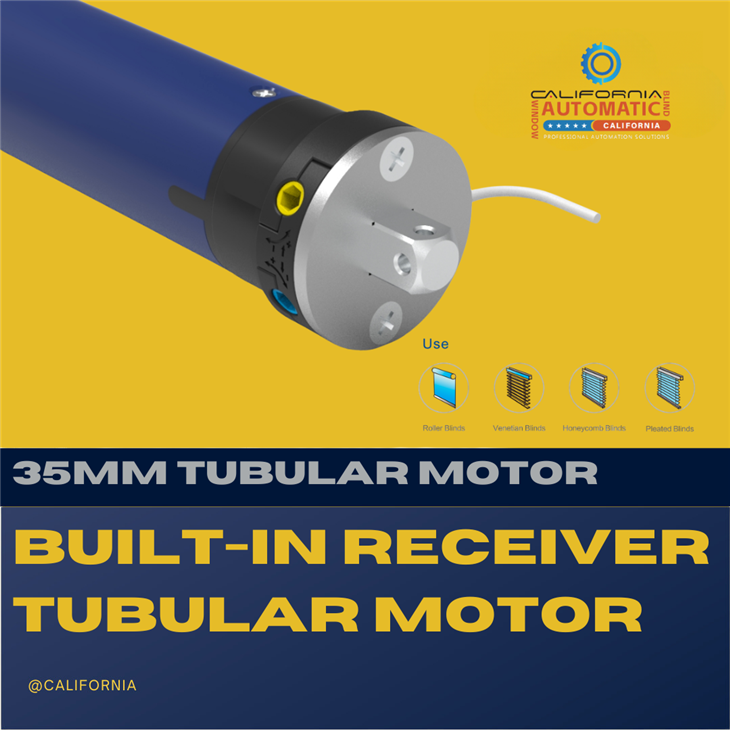
35mm Roller Blind Motor

Battery Tubular Motor
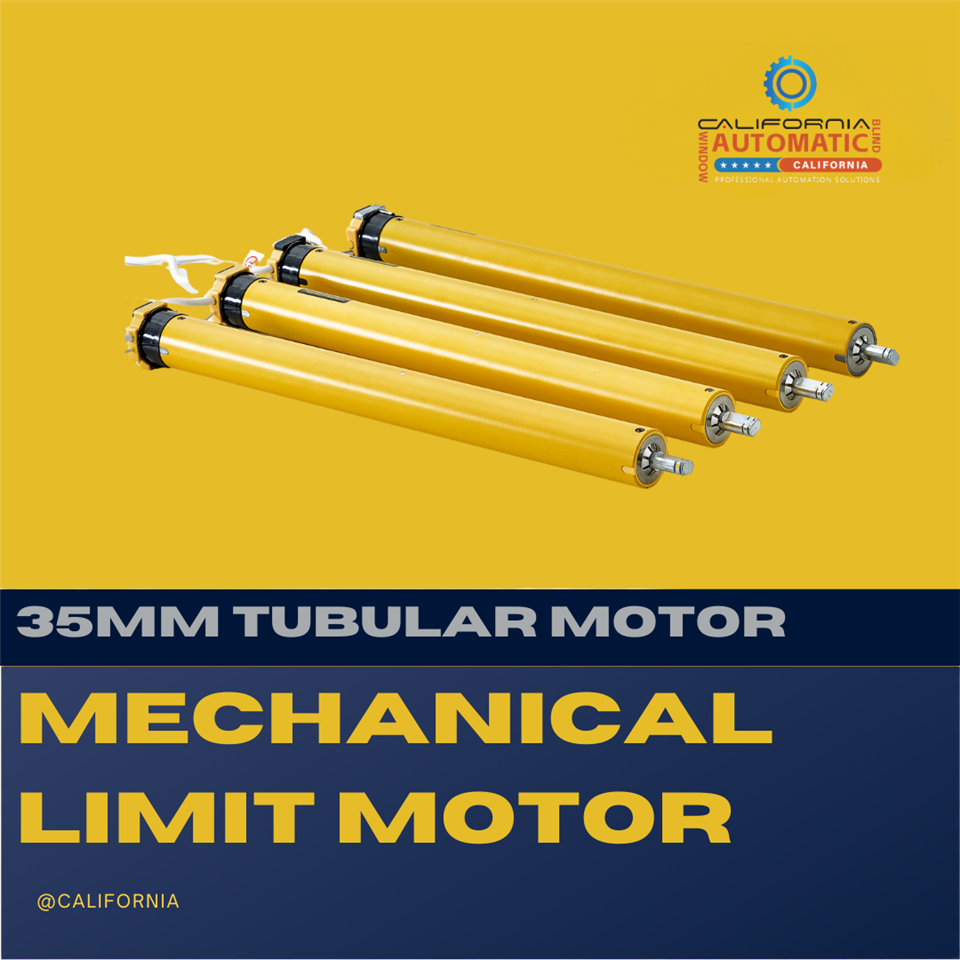
35MM Mechanical Tubular Motor
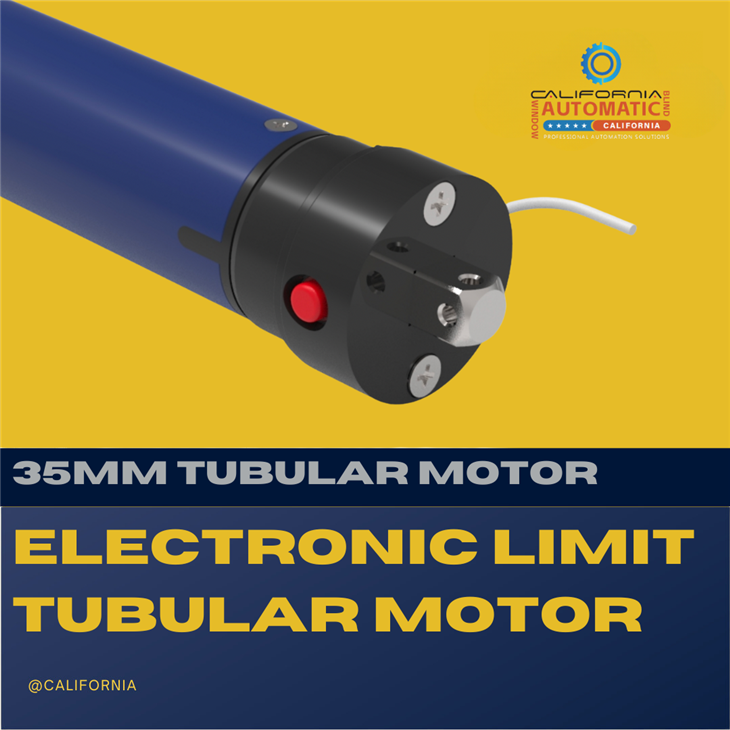
Electronic Limit Tubular Motor
2.4. Miniaturisation with High Torque
Designers demand narrow curtain boxes, while fabric weights increase. Traditional motors cannot fit, and small motors lack torque.
The industry demands miniature high-torque motors, but this conflicts with the thermal time constant. In a 25mm diameter tube, the surface area for heat dissipation is merely 0.02㎡. To achieve 1.2 N·m at 30 rpm (approx. 3.7W output power), the copper loss (I²R) generates ~5W of heat. Without a rated intermittent duty cycle (S2: 5 min), the internal temperature will rise to 120°C, demagnetizing the N45UH-grade neodymium magnets. Our 25mm series hits this torque spec by utilizing 0.2mm silicon steel laminations (vs. standard 0.35mm) to reduce eddy current loss by 40%, allowing a higher current density (6A/mm²) for short bursts.
Furthermore, our partnership with A-OK on prestigious projects like Shanghai's Tomson Riviera is not merely for prestige, but to demonstrate "installation fault tolerance". In high-end projects, once the curtain box is sealed, the replacement cost of a damaged motor accounts for 30% of the total construction cost. Our electronic limit features "power-off memory" (using FRAM storage with a write endurance of 10 billion cycles, far exceeding the 1 million cycles of standard EEPROM). This is the hidden, unspoken reason why large B2B clients choose us.
2.5. Enhanced Safety Mechanisms and Electronic Limits
Safety is a critical concern. Accidents such as door drops have plagued the industry. Traditional mechanical limit switches degrade over time.
The shift from mechanical to electronic limits is not just about accuracy; it's about fail-safe vs. fail-operational design. Mechanical switches fail "open" (circuit breaks), causing the motor to overrun. Our CA60's electronic limit uses a Hall-effect quadrature encoder that counts commutating pulses. Even if the MCU crashes, a separate hardware watchdog timer cuts the TRIAC gate drive within 200ms. The patented dual-brake system (one electromagnetic spring brake + one permanent magnet brake) provides a holding torque of 15 N·m, ensuring the door locks even during a total blackout, with the worm-gear manual override offering a 50:1 reduction ratio for effortless emergency cranking.
It is crucial to recognize that this dual-brake system adds $8.5 to the BOM cost, which is a deal-breaker for price-sensitive Southeast Asian markets. Therefore, we strategically target the high-end Middle Eastern villa sector (where sandstorms tend to jam traditional mechanical locks) and the European industrial door sector (where CE certification mandates EN 13241-1 compliance). Safety is not just a slogan; it is the market-entry currency for specific verticals.
3. What This Means for Distributors & Contractors
Having understood the core technical advantages, it is time to consider the commercial returns. Adopting cutting-edge motor technology is not just about upgrading performance; it is a strategic move to expand your business and reduce costs.
However, we translate these specs into sales ammunition: For contractors, the 50% reduction in installation time (thanks to wireless setup) translates to a 15% increase in daily job completion rates. For distributors, the <2% warranty return rate (due to electronic limit over-voltage protection up to 320V AC) cuts your after-sales labor cost allocation by nearly half. Our simplified structure lowers your operating costs.
4. Conclusion
Smart features, silent operation, and robust safety have become irreversible long-term trends. As an OEM/ODM manufacturer, WJZ Motor remains committed to technological innovation.
We currently supply customized low-noise variants to a Vietnamese partner specializing in hotel automation (acceptance standard <38dB at 1m distance), and maintain stable clients across the Middle East who prioritize sandproof sealing (IP67 rating on request). Our annual capacity reaches 60 million RMB (220,000 units). We have secured steady shipping slots with IRISL to guarantee delivery lead times (45 days FOB Shenzhen). Daily incoming material QC (MIL-STD-105E standard) ensures the field failure rate stays below 0.5% annually.

We welcome factory audits,witnessing the in-house gear hobbing and stator winding processes will clarify why our consistency outperforms assembly only workshops. For technical datasheets or customized shaft designs, please reach out-we commit to a response within 24 hours.